SPAN103
Intensive Beginners’ Spanish SPAN 103 is the first of a six-credit sequence of Intensive Spanish offered by the FHIS Department. The course, which is designed for highly motivated learners with previous experience in Spanish (i.e., BC Grade 11 or 12 Spanish) or other Romance languages, reviews the fundamentals of the Spanish language and expands on […]
RMST280
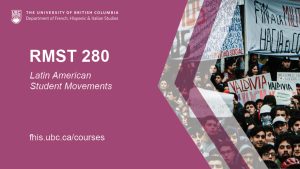
Love and Revolution Love is a central virtue of human kind that frames some of the most significant relationships and roles we will experience in our lifetime, particularly during times of change. From guerrilla movements and political upheaval to intimate acts of resistance and desire, we will examine how love in its various enactments—patriotic, romantic, […]
RMST306
Language Contact and Multilingualism in the Romance-Speaking World This course is about language contact and multilingualism in communities where different varieties of French, Spanish, Portuguese, Italian and other Romance-languages are spoken. Since the field of contact linguistics is inherently sociolinguistics, we pay equal attention to the social and linguistic settings of contact, as well as […]
RMST373
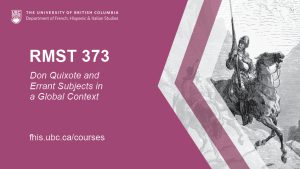
Don Quixote and Errant Subjects in a Global Context Discover Cervantes’s masterpiece, Don Quixote (1605), through close readings covering topics that range from gender, race, translation, economic crises, to religious turmoil and social inequality. By applying an interdisciplinary approach, Cervantes’s works will be discussed in relation to the artistic and historical context of renaissance and […]
ITAL380
Italian Food Cultures Cross-listed with RMST350 Italy is world-renowned for its food cultures and Italians put great care into food preparation, consumption, and appreciation. It’s no wonder that Italian food-related themes permeate the country’s cultural life and beyond. This course examines cultural representations of Italian or Italian-derived foods and the role that they play in […]
SPAN501
[Cross-listed with FREN 512B] Cultural Mobilities in Theory and Practice Cultural mobility can be defined as mobilities relayed in and of cultural products, events, and phenomena. The concept can be viewed as part of a recent, influential critical movement to foreground mobility in social sciences and in the humanities and arts. According to Tim Cresswell […]
ITAL378
Colonial and Postcolonial Italy Often considered the “least of the Great Powers” by its European colonial counterparts, Italy had nurtured expansionist ambitions since its Unification in 1861. At its peak, during fascism, the Italian Empire annexed parts of Libya, Greece, Albania, Eritrea, Ethiopia, and Somalia, in addition to a concession in Tianjin, China. But soon […]
FREN556D
Identity, Ideology and Power Instructor: Marie-Eve Bouchard Language of instruction: French This graduate seminar will delve into three critical themes in sociolinguistics and linguistic anthropology: ideology, identity, and power. Its broad objective is to examine how language ideologies are involved in the construction of power structure and social identities. Focusing largely on key articles, this […]
ITAL322
Italian for Reading Knowledge ITAL322 is a course for beginner and lower-intermediate students of Italian, or students with proficiency in any Romance language, including Latin. It is addressed to students who also want to develop their language skills and build their competences in order to understand the intersection of language, meaning-making and culture. It is […]
RMST452
Great Masters of Italian Cinema After the Neorealist Age Cross-listed with ITAL430 This course aims at familiarizing students from diverse backgrounds with master- pieces by some of the most acclaimed Italian film directors from the 1950s to our day. The films studied are classic works which explore and critically delve into (the industry would probably […]