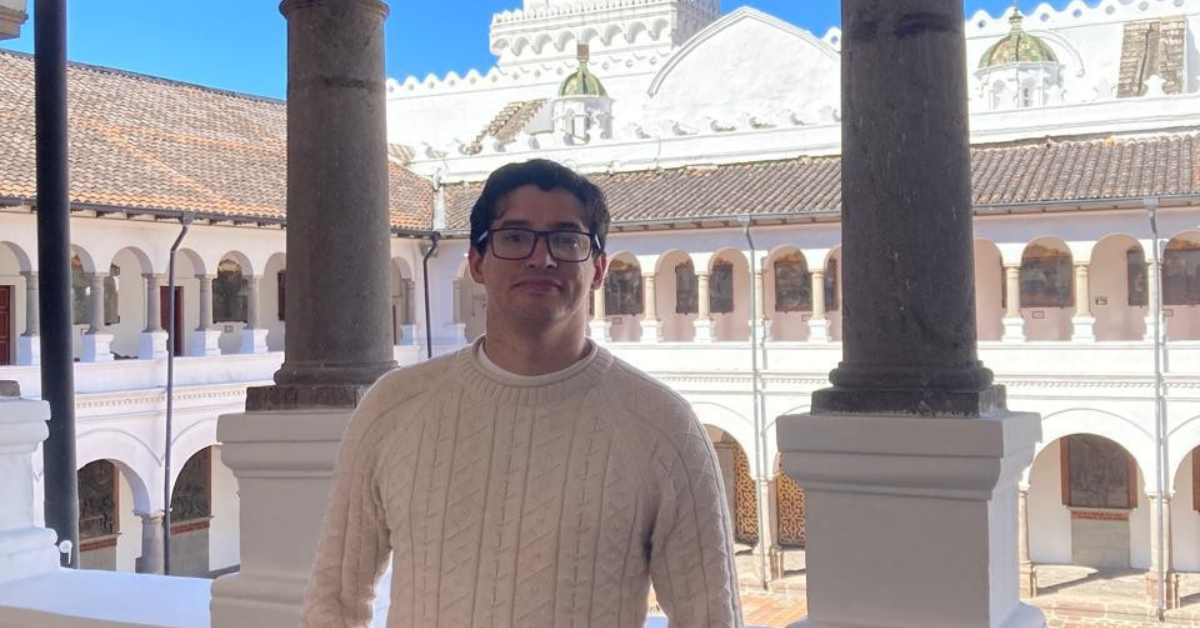
Not sure what Romance Studies is or why students choose it? You’re not alone. In this Q&A, undergraduate student David Chen shares how he personally found his way into the program—from his first courses in Italian Studies to studying abroad in Spain.
Daven Chen on a Parmigianno Reggiano Tour in Modena, Italy.
“I wanted to pursue a major that would allow me to take multiple Romance languages—all of which count toward one degree.”
David Chen
Major in Romance Studies
Why should students specialize in Romance Studies?
Students should major or minor in Romance Studies if they love learning languages—if they already speak French, Spanish, Italian, Romanian, Catalan, or Portuguese, perhaps—and have a passion to learn beyond the language. That is, they have a curiosity to learn about Francophone, Hispanic, Italian, and Lusophone cultures, foods, histories, cinema, or literatures.
Taught in English, the Romance Studies program offers an accessible way for us to learn, critique, and appreciate literature and cultural studies without sacrificing comprehension if we have not yet reached a certain level of language proficiency. While learning languages gives us linguistic proficiency, studying culture and history through Romance Studies courses allows us to gain deeper levels of cultural awareness toward the countries, peoples, and societies that speak the Romance languages.
Why did you, in particular, major in Romance Studies?
I’ve been learning Italian, Spanish, and French over the last four years, and I wanted to pursue a major that would allow me to take multiple Romance languages. Naturally, the Romance Studies program offers exactly that, allowing students like me to earn credits in French, Spanish, Italian, and Romance Studies (RMST) courses—all of which count toward one degree.
https://www.youtube.com/watch?v=99q9-KF7YjA
David Chen performing slam poetry in Spanish, French, and Italian during Arts Multilingual Week.
“While learning languages gives us linguistic proficiency, studying culture and history through Romance Studies courses allows us to gain deeper levels of cultural awareness.”
David Chen
I first discovered the Romance Studies program through a friend who was taking “RMST 350: Italian Food Cultures” two years before I eventually took it as well. It’s an amazing course taught by Dr. Gaoheng Zhang, Associate Professor of Italian, that examines the cultural and social power of Italian food in films, literature, and even cookbook memoirs.
Reunion with Dr. Elena Zampieri in Treviso, Italy (2025).
I eventually chose to major in Romance Studies after the last class I took with Dr. Elena Zampieri, former Lecturer of Italian Studies, who was instrumental in my Italian learning journey. She taught me to read and write poetry in Italian, and even encouraged me to perform my original work in a poetry slam contest for Arts Multilingual Week, and later in a literary prize competition at the University of Ca’ Foscari in Venice, where it won first place in the original Italian poetry category. My life changed significantly, and I was inspired and motivated to continue learning the Romance languages, while studying their cultures and histories through the voices of great poets, literary writers, and cinematic works.
What Romance Studies (RMST) course stood out to you?
Exploring historical landmarks during the RMST Global Seminar in Barcelona, Spain (2024).
“Standing in the very places where history happened made each lesson feel alive.”
David Chen
“
RMST 395A: Barcelona – Memory and Modernity” was one of the most memorable and impactful experiences I’ve had in my undergraduate life. It is a Go Global seminar held in Barcelona, Spain and taught by Dr. Anna Casas Aguilar, Associate Professor of Spanish.
During my time in Spain, I fell in love with the city of Barcelona and the on-site approach to learning Catalan history, literature, architecture, and culture through immersion. Dr. Casas Aguilar taught the class in English, and each day she led a group of 16 students to various historical landmarks to learn on-site, standing in the very places where history happened and making each lesson feel alive.
Being surrounded by a city that speaks both Spanish and Catalan deepened my appreciation for the social and historical importance and the rich cultural tapestry of Barcelona and the people of Catalonia. The most memorable day trip was visiting a cooking school to learn about the history and cultural significance of paella as we learned to make it on the spot. Whether it’s culture, history, cinema, literature, or food, Romance Studies has a bit of everything for everyone!
Paella lesson and demonstration during the RMST Global Seminar in Barcelona, Spain (2024).
I chose to take this course after remembering all the encouragement I received during office-hour conversations with Dr. Olga Albarran Caselles and Dr. Stephanie Spacciante, who taught me “SPAN 101: Beginners’ Spanish I” and “SPAN 201: Elementary Spanish I“, respectively. I was completely enamored by their travel stories and memories of living in Madrid, Mexico City, Machu Picchu, and so much more. Little did I know that these conversations would have such a profound impact on me, inspiring me to take the first step toward studying in Spain.
RMST Global Seminar class in Barcelona, Spain (2024).